ARTICLE/MANIFESTO
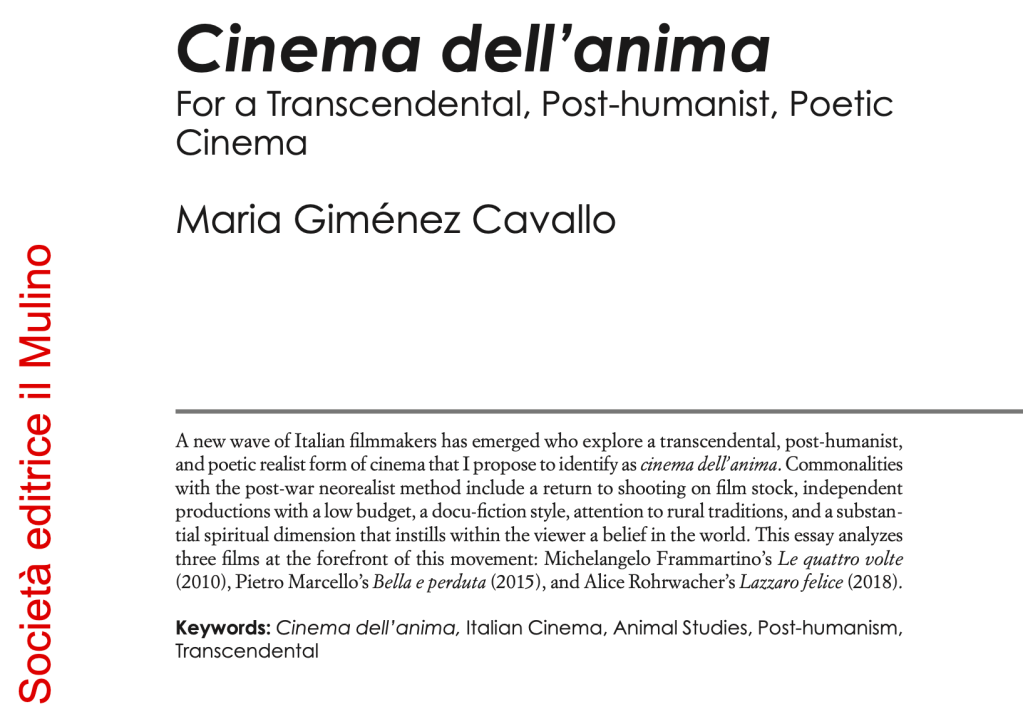
For more information on this movement, check out my analysis published in L’avventura, International Journal of Italian Film and Media Landscapes 1/2021: 3-22.
Click on the link to read the full article: “Cinema dell’anima. For a Transcendental, Post-humanist, Poetic Cinema”
VIDEO ESSAY
Filming the Soul: the Cinema dell’anima movement in Contemporary Italian Cinema
In recent years, there has arisen a new wave of Italian filmmakers who independently but
consistently develop a humanist, posthumanist, poetic realist, and magical neorealist, form of
cinema, in which they often shoot on 16mm, use a docu-fiction method, explore rural traditions,
include non-human (animal) characters, and, above all, illustrate the invisible nature of the soul.
In a previous article, I proposed to name this movement cinema dell’anima, identifying
Michelangelo Frammartino, Pietro Marcello, and Alice Rohrwacher as the forerunner auteurs
who, each in their own individual way, seek to portray the soul onscreen.
This video essay uses clips from “Le quattro volte”, “Bella e perduta”, and “Lazzaro felice” to analyze how a posthumanist poetic and anthropological subjectivity can affect the viewer and change perceptions of the outside world through the cinematic medium.
As Gilles Deleuze stated: “The question is no longer: does cinema give us the illusion of the world? But: how does cinema restore our belief in the world?” By making the invisible visible, and, more specifically, by making palpable the intangible soul, cinema dell’anima can thus be considered an expression of faith and an effort to raise awareness around us in the hopes of making the world a better place.
Presented in the Keynote Speech at the Canadian Association of Italian Studies for their Annual Conference at the University of Bologna, June 9th 2025.
A former version was also presented at the Journal of Italian Cinema & Media Studies Conference “Italian Cinema and Media: Past and Present, Continuity and Change, Expectations for the Future” Rome, June 16-18 2022.
PODCAST – Capolavoro! Cinema dell’anima
Hosted by: Ken Barrett (UK based visual artist, writer, podcaster) and Russ Kilbourn (Wilfrid Laurier University, Canada)
In this podcast we discuss Maria Giménez Cavallo’s concept of ‘cinema dell’anima’, (Cinema of the Soul), an idea triggered by three Italian films from the last two decades. Maria’s concept has three elements and she highlights a film for each: transcendental – ‘ Le Quattro Volte’ (2010) directed by Michelangelo Frammartino; posthumanism – ‘Bella e Perduta’ (2015) directed by Pietro Marcello; poetic realism – ‘Lazzaro Felice’ (2018) directed by Alice Rohrwacher. Maria outlines the story of each film and the aspects that support her thesis and we go on to discuss other films that can be categorised in this way and writers who have influenced Maria’s thinking, including Paul Schrader’s book ‘Transcendental style in film’ and Gilles Deleuze’s Cinema 2, and other directors. Maria also speaks about having worked with Marcello and Rohrwacher on their recent documentary ‘Futura’ and how filming in Sardinia led to her own first feature ‘Anime Galleggianti’ (Wandering Souls) a reimagining of Ovid’s ‘Metamorphoses’, and she also talks about her upcoming film.
 anima films